Showing posts with label RRA_Coyote_Carbine. Show all posts

Tuesday, May 11, 2010

Rock River Arms (RRA) Coyote Carbine Review Part 5 - Parts, Pros, Cons, and Bottom Line

Rock River Review, RRA Review, Rock River Arms Review

I have broken down my review of the Rock River Arms Coyote Carbine into several different parts shown below.  Also below are the key Pros and Cons along with my Bottom Line remarks.
  1. Rock River Arms (RRA) Coyote Carbine Review Part 1 - The Acquisition
  2. Rock River Arms (RRA) Coyote Carbine Review Part 2 - What's In The Box
  3. Rock River Arms (RRA) Coyote Carbine Review Part 3 - The Rifle
  4. Rock River Arms (RRA) Coyote Carbine Review Part 4 - The Range Test
  5. Rock River Arms (RRA) Coyote Carbine Review Part 5 - Parts, Pros, Cons, and Bottom Line (this page)
Pros
  • 3/4" MOA capable rifle and the range test results support this claim
  • Lite weight (7.0 lbs)
  • Includes Hogue handrail and pistol grip
  • Includes two stage trigger
  • Includes gun case large enough to allow additional accessories
Cons
  • The rifle I reviewed did not have the latest RRA Operator A2 stock, although I did like the ACE AFRX Skeleton Stock
Bottom Line
There are many good AR style rifle manufacturers on the market today and I believe that Rock River Arms clearly falls within this group.  They are one of the few willing to make some significant claims on the accuracy of their rifles and I believe those claims to be true in the case of the Coyote Carbine.  Would I purchase this rifle?  Yes.  I like RRA because I think they offer good quality and value in their rifle because of the features that are provided standard with this rifle.  Should you purchase this rifle?  I recommend that you do your research and look at reviews of any rifles you are considering.  I have a hard time believing you would be dissatisfied with the Rock River Arms Coyote Carbine.  In the end, it is your investment and research is part of the fun.

Rock River Arms (RRA) Coyote Carbine Review Part 4 - The Range Test

Rock River Review, RRA Review, Buffalo Bore Review, Rock River Arms Review, 223 Review
It seems that every time I go to the range the weather conditions give me an excuse for less than perfect marksmanship and this range test was no exception.  Just to make it clear, this was probably the windiest day I have ever had at the range.  You can see from the flag below, the wind was harsh.  At times, the wind force was hitting my body and I could see my crosshairs move on the target.  The good part was that most of the time the wind was hitting me in the face (not a cross wind).  Enough with the excuses, now for the review.


I borrowed the Rock River Coyote Carbine from my brother-in-law and he had already taken it to the range twice, both times were with cheap plinking ammo.  For my range tests, I did bring some more plinking ammo (Wolf 55 grain FMJ), but I also got a couple of boxes of Buffalo Bore Sniper 55 grain and 69 grain ammo.  I was extremely pleased with the results I got with the Buffalo Bore Sniper .308 ammo with my FNAR review, so it seemed natural to test out their .223 Sniper ammo.

Wolf Military Classic 55 Grain FMJ

Buffalo Bore Sniper 55 Grain Ballistic Tip

Buffalo Bore Sniper 69 Grain Jacketed Hollow Point

I started off shooting with the Wolf ammo and had to adjust the scope slightly since I had removed it for the rifle review.  Also I used this ammo to get a better feel for the trigger pull and to make sure my rest situation was good.


Next I switched to the Buffalo Bore Sniper 55 grain ammo.  I shot two 3 shot groups.  One measured 1.50" and the other 0.83" shown below.  While looking through the scope, I was pleased with the results so far considering the windy conditions.


As I started my next three shot group with the 55 grain ammo, I had my first of three rifle jams.  The photo below shows the jam.  Each time the rifle seemed as if the bolt was not extracting the brass and then was trying to send another round on top.  The first two times I removed the magazine, closed the bolt firmly and ejected the brass.  I removed the bolt and carrier and cleaned the rifle.  On the third time, it did the same thing.  This time I had to use a cleaning rod down the barrel to assist with the brass removal.  It wasn't that the brass was hung up in the chamber, it was that the bolt carrier seemed to be dragging.  Again I disassembled the rifle and this time I found a small piece of metallic trash (primer-ish looking) in the bolt carrier.  I reassembled the rifle and it functioned flawlessly throughout the rest of the tests.  I still don't know how that trash got in the carrier assembly.  For now, I'm going to have to take the blame and assume that my cleaning efforts were not up to par.


Since this was not my rifle, and just to play it safe, I decided to forgo shooting the rest of the Buffalo Bore 55 grain ammo.  The last thing I wanted was to return a problem back to my brother-in-law.  I then switched to the Buffalo Bore Sniper 69 grain ammo.  Using this ammo, I shot five 3 shot groups.  These groups measured 0.55", 0.90", 1.10", 1.28", and 1.50".  The average group size was 1.07" with my best group shown below.


Just to run some more ammo through the rifle and make sure the scope was where it should be for plinking ammo, I shot another six 3 shot groups with the Wolf ammo.  The groups were 1.16", 1.28", 1.45", 1.47" 1.53", and 1.76".  This average group size was 1.44" which is probably respectable considering the cost of the ammo.

Bottom Line: 
I don't think the rifle jam was due to the rifle or the ammo, but instead some type of metallic particle in the bolt and carrier assembly.  It functioned perfectly throughout the remainder of the tests.  Do I think this rifle is 3/4" MOA capable?  I had one group very close with the 55 grain Buffalo Bore ammo and one with the 69 grain Buffalo Bore ammo that clearly shows the rifles potential.  My average group size with the 69 grain ammo was 1.07".  Considering the windy conditions, I believe I could do better on a calm day and this decrease in accuracy from 3/4" to a little over 1" can be easily accounted for by the windy conditions.

Sunday, May 9, 2010

Rock River Arms (RRA) Coyote Carbine Review Part 3 - The Rifle

Rock River Review, RRA Review, Rock River Arms Review, LAR-15 Review
With so may AR style rifles on the market and so many interchangeable accessories, many features and details on this rifle are common with the other rifles on the market.  In this portion of the review, I'm going to try and give you enough photos and data so that you can see what may be common and what may be different.  The best place to start reviewing the rifle will be with the Rock River Arms Coyote Carbine advertised specifications shown in the photo below from the Rock River Arms website.  Note: Remember that the picture below shows the newer RRA Operator A2 stock and the rifle I'm reviewing has the older ACE AFRX Skeleton Stock.


Caliber
The carbine comes in the 5.56x45mm NATO caliber which means it can also safely fire .223 Remington.

Upper Receiver
The rifle comes with a forged A4 upper receiver.  Actually it is made from forged and milled 7075 T6 aluminum alloy that is then hard anodized.  This is common with many AR makers on the market today.  Some of the key components of the upper receiver assembly are the charging handle, integrated upper rail, forward assist, ejection port cover assembly, and shell deflector.


Barrel
The rifle comes with a 16" chrome moly heavy barrel.  The rifling's are at a 1:9 twist.  This twist rate should stabilize up to 69 grain bullets.


Muzzle Device
The rifle comes with a Smith Vortex Flash Hider.  The key points for this flash hider are taken from their literature as shown below in italics.

Based on the combat-proven Vortex® 5.56mm G6A1 system, the definitive development of the patented Vortex® design now features a 40% increase in structural rigidity. The new G6A2 model features our patented 15-degree helix, guaranteeing a complete propellant burn and negligible flash, unlike the standard issue closed-end “bird cage” unit or competing straight-flute designs. Right hand helical flutes will not loosen under sustained fire. The flute configuration is 40% stronger due to greater mass. The aligning of exiting gases helps to improve overall accuracy.  The G6A2 also serves as a quick-connecting interface for our new M4DC CQB Sound and Flash Suppressor.


Trigger
The rifle comes with the RRA Two Stage Match Trigger and RRA Winter Trigger Guard.  I really like the trigger on this rifle, especially when compared to my old Colt AR-15 Sporter II.  The RRA Two Stage Match Trigger comes to a stop at about 0.08" (measured at the tip of the trigger) when pulling through the first stage using 2.23 pounds of force.  During the second stage, there is no detectable movement as you increase your pulling force to 3.05 pounds and the hammer releases.  When shooting the rifle, a slight increase in pressure with your finger will probably surprise you during your first couple of shots.  I like the looks and functionality of the Winter Trigger Guard, but am not sure I want to pull this trigger while wearing gloves.


Handguard
The handguard is the Hogue AR-15/M-16 (Carbine) Free Float Foreend with OverMolded Rubber Gripping area.  The rubber gripping area is the textured area shown below in the middle of the handguard.  I really like the way the rubber seems to make the rifle stick to your hand.


Pistol Grip
The pistol grip is the Hogue AR-15/M-16 Rubber Grip with Finger Grooves.  Just like the handgaurd, the texture feels good in your hand and I have a personal preference for finger grooves.


Buttstock
The rifle I'm reviewing did  not have the new RRA Operator A2 Stock.  It actually has the ACE AFRX Skeleton Stock.  Since I'm 6' 2", I found the buttstock to be a little short for my preference, although shortness is the key point of a carbine rifle.  Also, I'm sure that a thick coat would give a better feel.  There is foam surrounding the buffer tube portion of the stock.  This foam makes a cheek weld comfortable.


Lower Receiver
The lower receiver is also made from forged and milled 7075 T6 aluminum.  The lower receiver assembly contains the trigger assembly, safety selector, bolt release, magazine release, and take down pins.


Bolt & Carrier Assembly
As you can see from the wear on the bottom of the carrier assembly, this rifle has already been to the range three times.


Weight
The rifle weighed in just as advertised, 6.99 pounds (basically 7.0 lbs).  Remember that this is the empty weight, with no magazine or sights/scope.  The final rifle with mounts, scope and a full magazine weighed in at TBD pounds.


Upper to Lower Receiver Fit
I checked the fit between the upper and lower receiver by rotating them such that all the slack was to one side.  I then inserted a feeler gage and measured the gap.  In general the gap was about 0.006" throughout.  It did tighten at the rear end slightly, but only to about 0.005".  This gap is clearly less than my older Sporter II, but I'm going to have to review many more rifles to get a better feel for how this compares to other manufacturers. 


The Rifle
I have tried to show enough photos and data to give you a good idea of this rifle's features and quality.  Overall fit and finish of the rifle seems good and the incorporation of aftermarket grips and stock makes it a good choice for those value minded people wanting to get these accessories anyway.  I remounted the Burris PEPR mount and Nikon Coyote Special Scope back on the rifle and will write up a review of those items in the near future.  You can see the setup below.  Also showns is a Harris Bipod.


Remember that this rifle is advertised as having 3/4" MOA accuracy.  Part 4 will cover my range testing.  3/4" MOA is a pretty aggressive claim for any rifle of this type, but just to give you a preview, take a look at the group below.  This was my best group at 100 yards (0.55" three shot group).  My feeling is that it is capable of 3/4" MOA.

Wednesday, May 5, 2010

Rock River Arms (RRA) Coyote Carbine Review Part 2 - What's In The Box

Rock River Review, RRA Review, RRA Coyote Rifle Review
As with any of my reviews, I like to talk about the packaging and everything in the box.  I'm not going to go into the details of the rifle in this portion of the review, but I feel there is some valuable information to be gained by reading this portion of the review.

The photo below is of the closed case.  When I first saw the case, I was glad to see the manufacturer provided a case that would allow use after the installation of optics and accessories.  The outside of the case measures about 14.5" x 38.5" x 3.75".  Remember that if you click on a photo, it should bring up a higher resolution photo.


Inside the case was the rifle, one magazine, warranty card, Operators Manual, and a chamber plug.  Since I recieved it from my brother-in-law, I was not sure.  Based on the Rock River website, this should have been everything.  One thing to notice in the photo below is that I have the rifle in narrowest portion of the case and the case will close.  Also you will see this case has more than enough room for a scoped rifle with foregrip and multiple magazines.  I also prefer the latch style locks shown over the sliding style on some cases.  Not that a case makes a rifle, but if it were my rifle, I would be glad that I didn't have to immediately purchase another case before I headed off to the range. The inside of the case measures 13.38" x 36.13" with about 1.2" egg crate foam on each side.


While I was checking out the Rock River Arms website, I discovered a slight difference in my review rifle and RRA's advertising photo.  As you can see, above the review rifle has the ACE AFRX Skeleton Stock and the photo below has the RRA Operator A2 Stock.  In the photo below from RRA's website, you will see that "they will begin shipping with the new RRA Operator A2 Stock as soon as inventories allow."  So beware if you are really wanting the stock below, you may need to verify that before you take the rifle home.


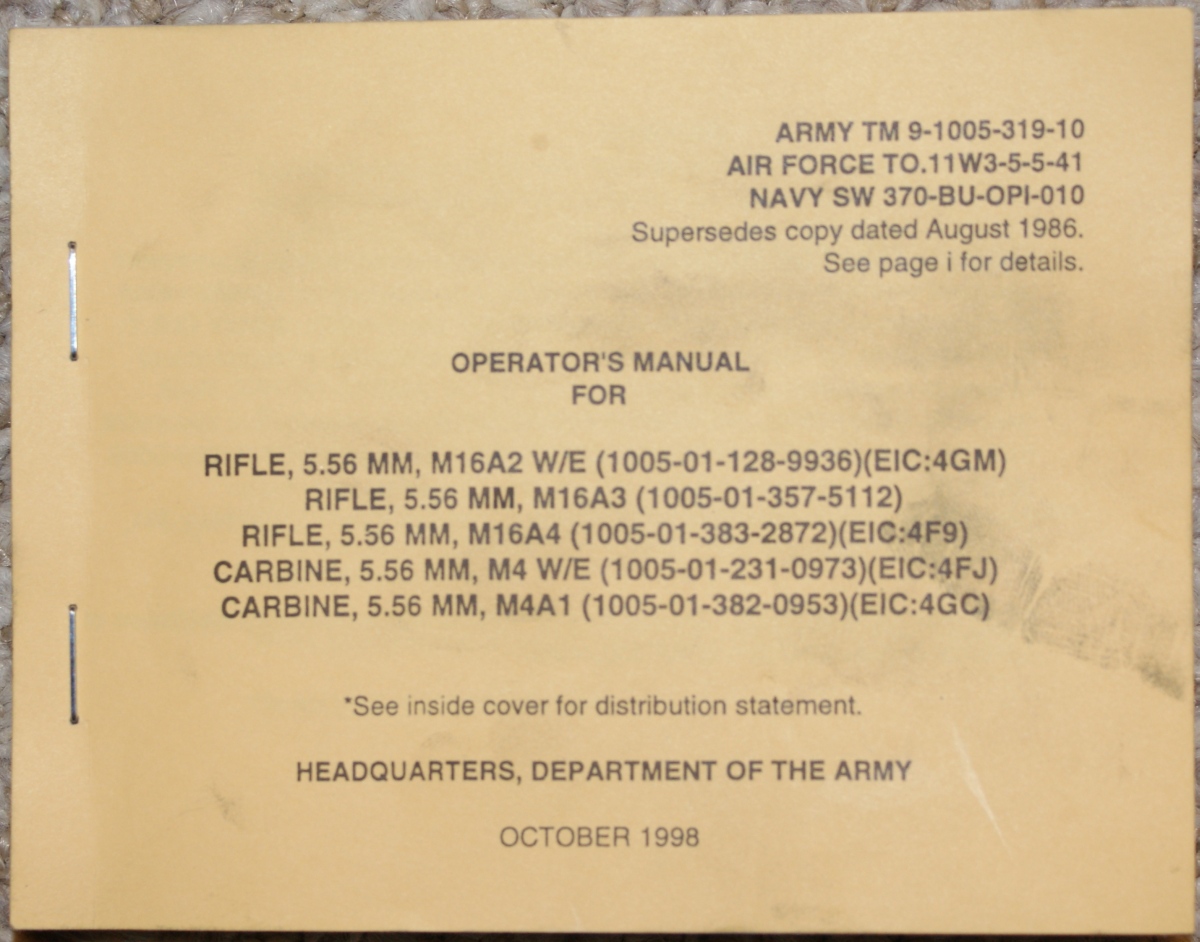
Worth showing is the Operators Manual and Warranty Card that comes with the rifle.  I think the Operators Manual being from 1998 is a great novelty and has a lot of good information, but I would have thought any rifle with a MSRP of $1190 should have a specific manual for the configuration of the rifle instead of a generic manual that is nearly 12 years old.  Regardless, the information is mostly applicable and is useful.


In the box was also one 20 round magazine, but since I'm not sure if the one he sent me is the one originally from Rock River, I'm going to update this post once I find out the actual details.

And finally there is the rifle, which is probably the main reason you are reading the review.  I'm going to go into great detail about the rifle in the next portion of the review.  Until then, here is a high resolution photo for you to be able to take a look at some details.  Keep in mind, the rifle has been to the range at least twice so you may see a scuff or two.


So far I like what I see.  The only thing to watch if purchasing the rifle is which style stock may come in the box.  Also, it is good to have a case big enough for long term use.  In Part 3, I'm going to be looking at the rifle in great detail, so check back later this week.  Also range testing is planned for Saturday.

Tuesday, May 4, 2010

Rock River Arms (RRA) Coyote Carbine Review Part 1 - The Acquisition

Rock River Review, RRA Review, RRA Coyote Rifle Review
Last month my brother-in-law purchased a new Rock River Coyote Carbine .223 rifle.  Over the weekend I got a chance to check it out and was extremely impressed with the rifle. Since he live out of town, he let me take it home so I could spend more time reviewing the rifle.  He purchased the rifle from Hit and Run in Tucker, Georgia for $1122.43 out the door and said there were Rock River Arms cases everywhere in the store.  Even though he had his scope mounted on the rifle, I decided to remove the scope and mounts for two reasons.  First, I want to review the rifle before any accessories are added.  Second, I want to review the Burris AR-P.E.P.R.™ Mount and the Nikon Coyote Special 3-9x40mm Scope.  The picture below shows his setup before removing these items.  There were several positive things that really stood out from my first impression such as eye appeal, light weight, grips, and trigger pull.


The picture below is my brother-in-law shooting some 100 yard groups with cheap ammo just to get the scope sighted in better and to see how some cheap ammo would group.  I'm not going get into accuracy yet, but out of three different shooters, we had a max group of 1.55" and min group of 1.30" with Wolf  Military Classic 55 gr. FMJ.  Not bad for cheap ammo, but this weekend I plan to put accuracy (or my shooting abilities) to the test with some Buffalo Bore Sniper 55 gr. and 69 gr. ammunition.  I was real happy with the results I got with Buffalo Bore Sniper ammunition using my FNAR and thought I would try some out on this 3/4" MOA advertised rifle.


This review will be broken down into multiple posts and then I will do a final summary that ties all the portions together.  Make sure you check back regularly to see the progression of this review.